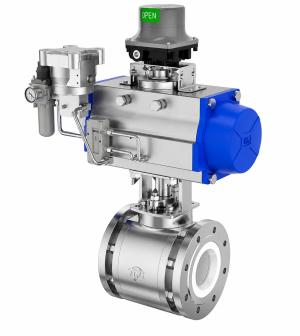
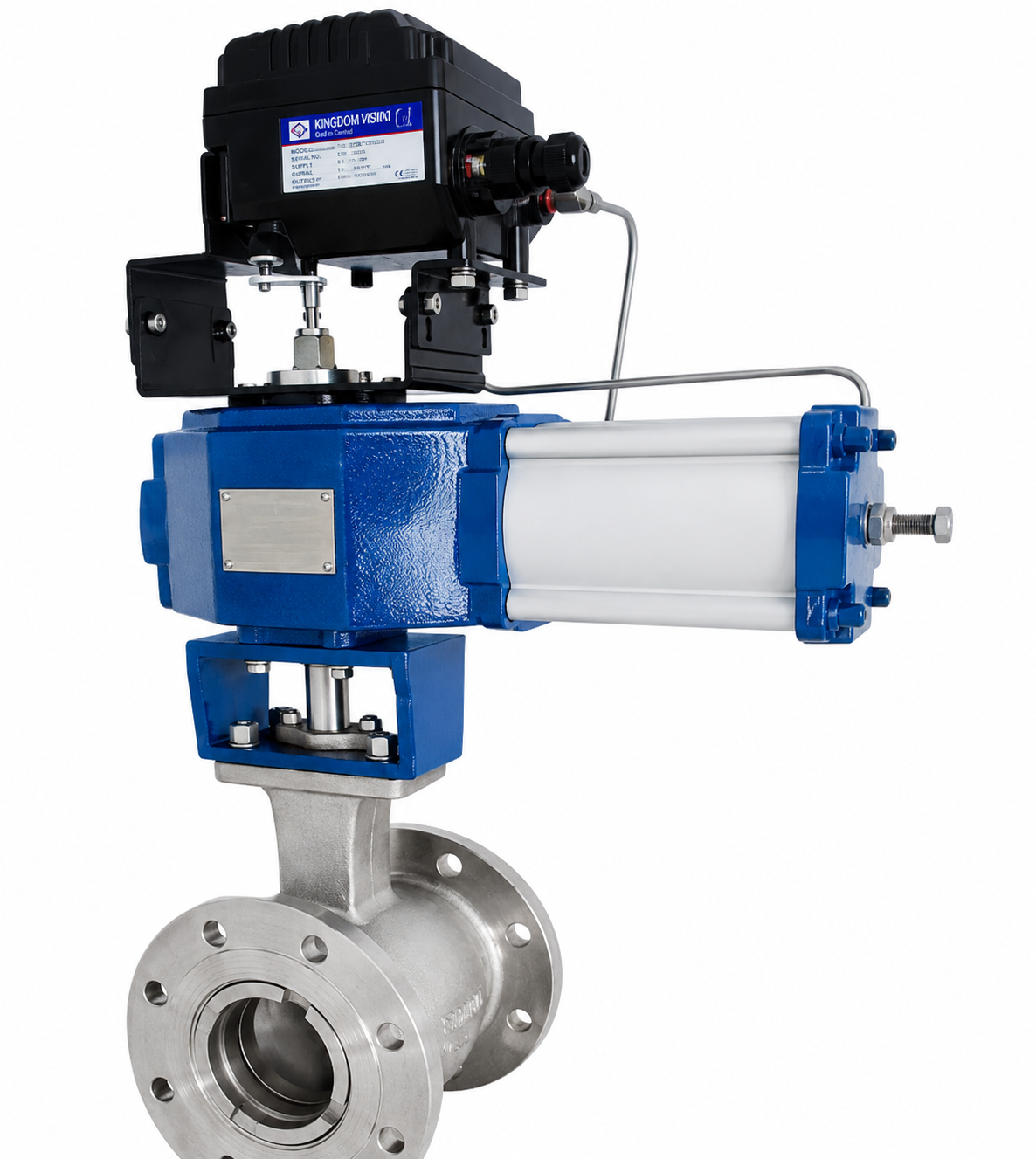
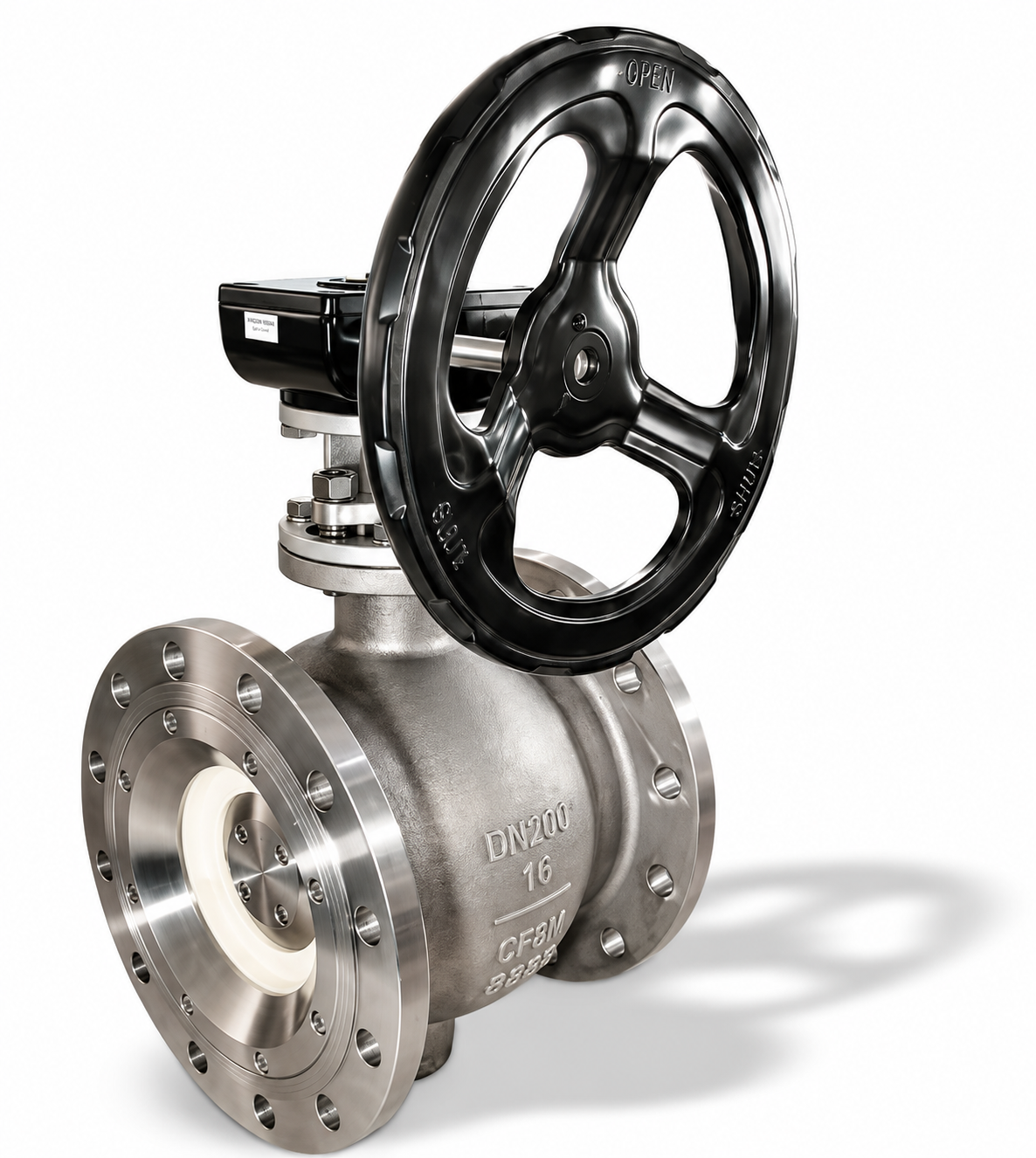
KVC-RP Eccentric Ball Valve
The KVC-RP is an eccentric angle-stroke rotary control valve designed around a guided eccentric valve shaft and a spherical contoured plug/ball. Its design combines the compact operating principle of a rotary valve with the controllability associated with a globe control valve.
KVC-RP Eccentric Ball Valve – Rotary Globe Control Valve
The KVC-RP is an eccentric angle-stroke rotary control valve designed around a guided eccentric valve shaft and a spherical contoured plug/ball. Its design combines the compact operating principle of a rotary valve with the controllability associated with a globe control valve.
The result is a distinctive control-valve solution for applications where process conditions can make conventional valve selection challenging.
The KVC- RP is designed for services involving polluted media, pulp, limestone, solid granular media, viscous media, cavitation and erosion.
For South African mining, minerals processing, pulp and paper and general process plants dealing with difficult fluids, the KVC-RP provides an alternative against conventional linear and rotary control-valve technologies.
What Is the KVC-RP Eccentric Ball Valve?
The KVC-RP is an eccentric angle-stroke control valve.
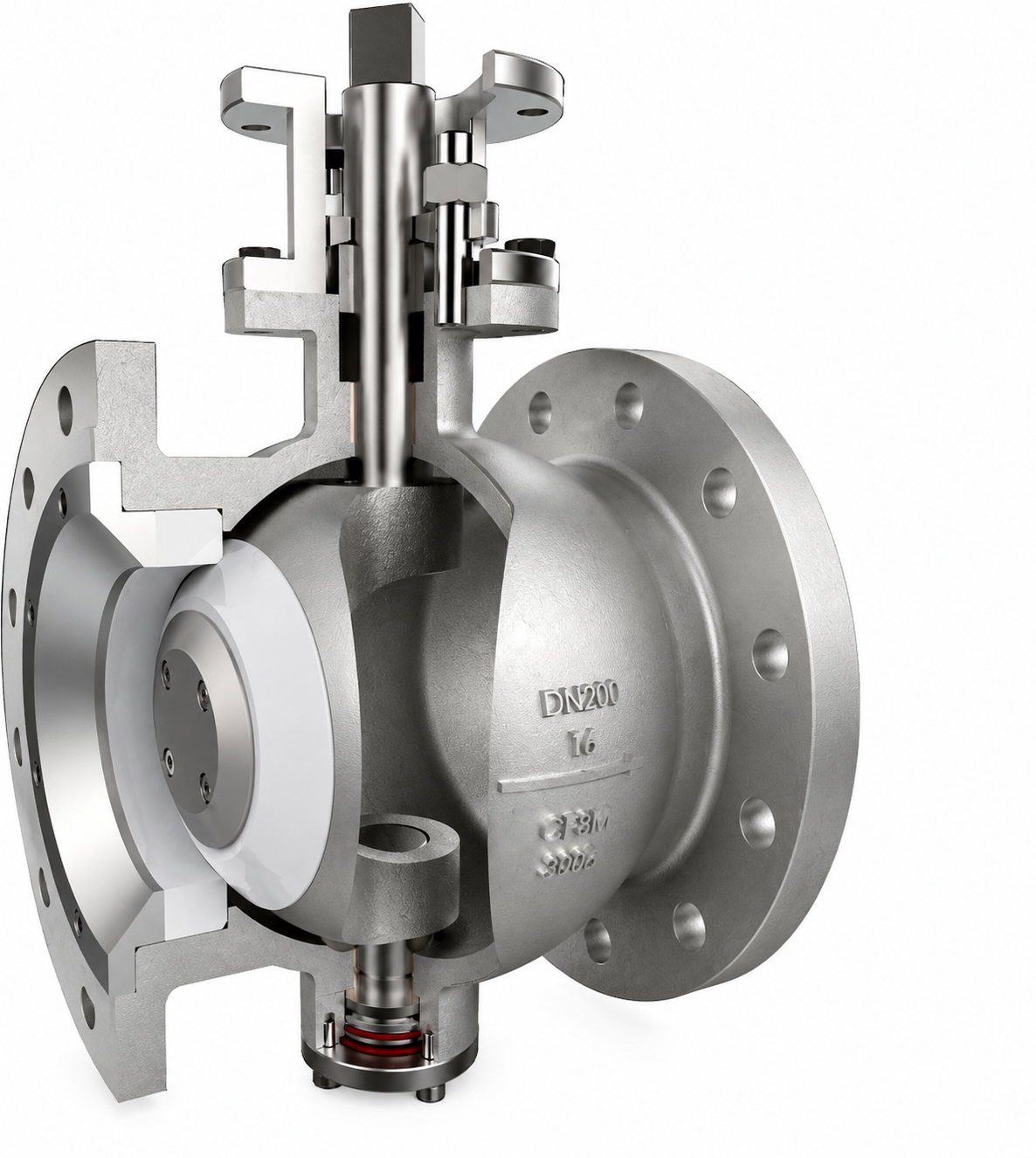
Unlike a conventional concentric rotary ball arrangement, the RP uses a guided eccentric valve shaft together with a spherical contoured plug/ball for flow control. The valve's eccentric geometry means that the plug makes contact with the seat only near the final stage of closing.
This operating principle is important because it reduces friction between the plug and seat through much of the valve's travel. Our technical literature describes this as a low-torque design.
The design is referred to as “Rotary Globe Valve” because the design provides globe-control-valve controllability in a compact rotary configuration.
Why Use an Eccentric Rotary Control Valve?
Control-valve selection becomes more demanding when the process fluid is dirty, viscous, contains solids or creates erosive or cavitating conditions.
The KVC-RP addresses these applications through its eccentric rotary geometry.
Its plug is offset from the valve's rotational axis so that continuous rubbing against the seat is avoided through most of the stroke. Contact occurs near final closure rather than throughout the complete rotary movement.
This design contributes to reduced operating friction and torque while still allowing the contoured plug to regulate flow.
The KVC-RP also incorporates linear seating motion due to the eccentric plug design.
For engineers comparing control-valve technologies, this combination of rotary movement, eccentric seating and a contoured flow-control element is what distinguishes the RP concept from a conventional general-purpose ball valve.
Key Features of the KVC-RP Eccentric Ball Valve
Globe-Valve Controllability in a Rotary Design
The KVC-RP eccentric ball valve provides the controllability of a globe control valve while using a compact rotary design.
Eccentric Plug for Reduced Friction and Torque
The eccentric plug contacts the seat only near the final moment of closure.
Because the sealing surfaces are not continuously rubbing against one another throughout the valve stroke, friction is reduced. This contributes to lower torque requirements compared with a design in which the sealing surfaces remain in contact throughout travel.
Final actuator selection must nevertheless be based on the actual valve size, pressure differential, shut-off requirement and process conditions.
Linear Flow Characteristic
The KVC-RP has an inherent linear flow characteristic with a fairly high turn down ratio.
Inherent adjustable ratio: 100:1
This makes flow characteristic and required operating range important considerations when we size an RP valve for a control application.
Linear Seating Motion
Although the KVC-RP operates as a rotary valve, its eccentric plug geometry produces linear seating motion as the plug approaches the seat.
This characteristic forms part of the valve's eccentric seating concept and helps distinguish the RP from conventional concentric rotary valve arrangements.
Replaceable Seat
The valve is constructed with maintenance in mind.
The seat can be replaced by removing the retaining ring, rather than treating the seat as a permanently integral component.
Both metal-seat and soft-seat options are documented.
The appropriate seat configuration depends on process temperature, leakage requirement, medium and service conditions.
Integral Body Construction
The KVC-RP uses an integral body design in which the valve body and bonnet are cast as one body.
The product literature describes this arrangement as having no static or dynamic seals other than the packing seals.
Rotary Operation and Packing
Rotary operation is intended to improve packing life compared with arrangements involving repeated linear stem movement.
The documented packing options include:
- PTFE: -40°C to +150°C
- Flexible graphite: -40°C to +400°C
Packing selection must therefore be matched to the actual process temperature and operating conditions.
KVC-RP Technical Specifications
| Parameter | KVC-RP specification |
|---|---|
| Valve type | Eccentric angle-stroke control valve |
| Product designation | RP Eccentric Ball Valve / Rotary Globe Valve |
| Nominal size | DN50–DN300 |
| Connection | Flanged |
| Face-to-face length | ASME/ISA S75.04 |
| Temperature range | -40°C to +400°C |
| Inherent flow characteristic | Approximately linear |
| Adjustable ratio | 100:1 |
| Rotation | Clockwise closure |
| Standard leakage | Class IV according to ANSI/FCI 70-2-2006 |
| Optional leakage | Class VI bubble-tight option according to ANSI/FCI 70-2-2006 |
| Seat options | Metal seated / soft seated |
| Packing options | PTFE / flexible graphite |
| Body material options stated | WCB, CF8M, CF8, SAF2205 |
| Trim examples stated | 316 + alloy, tungsten |
| Special options | Thermal insulation jacket, erosion-resistant design, low-noise design |
Engineering note: Pressure capability is dependent on body material and temperature. Valve selection should therefore be made against the applicable pressure-temperature data rather than treating nominal pressure designation as a constant allowable working pressure at every temperature.
Rated Cv of the KVC-RP
Our technical literature provides the following rated Cv values for DN50 through DN300.
| Nominal Size DN | Inch | Rated Cv – Metal Seated | Rated Cv – Soft Seated |
| 50 | 2 | 50 | 50 |
| 65 | 2½ | 100 | 85 |
| 80 | 3 | 150 | 120 |
| 100 | 4 | 240 | 195 |
| 125 | 5 | 320 | 290 |
| 150 | 6 | 500 | 480 |
| 200 | 8 | 800 | 800 |
| 250 | 10 | 1250 | 1150 |
| 300 | 12 | 1800 | 1550 |
These values should be used as rated Cv data, not as a substitute for control-valve sizing.
Correct valve sizing requires evaluation of the actual process conditions, including required flow, upstream and downstream pressures, fluid properties, temperature and operating range.
At KV Controls, we recommend selecting the valve from the required operating Cv rather than simply matching the valve nominal diameter to the pipeline diameter.
Metal Seat or Soft Seat?
The KVC-RP is available with both metal and soft seating arrangements with the option of ceramic seat and ball.
There is standard combinations including stainless-steel and hard-faced metal seats as well as PTFE soft-seat arrangements.
Choosing between them requires consideration of the actual service.
Metal-Seated KVC-RP
A metal-seat configuration should be considered where the process conditions make a soft seat unsuitable, particularly where temperature, erosion or the nature of the process medium needs to be taken into account.
The standard leakage for the RP is ANSI/FCI 70-2-2006 Class IV.
Soft-Seated KVC-RP
A soft seat is available where the process and temperature conditions permit it.
Class VI bubble-tight option according to ANSI/FCI 70-2-2006.
Seat selection should never be based on leakage class alone. Temperature, differential pressure, medium compatibility, solids, erosion and required service life must also be considered.
Body and Trim Material Options
Our RP body material options including:
- WCB
- CF8
- CF8M
- SAF2205
Trim examples include 316 plus alloy or tungsten, depending on configuration, ceramic is also available.
Material selection should always be confirmed against the process medium, temperature, pressure, corrosion conditions and erosive characteristics of the service.
If your project requires a particular metallurgy, send the material requirement to our engineering team for confirmation rather than assuming availability from a general material description.
KVC-RP for Dirty and Difficult Process Media
One of the most important aspects of the KVC-RP is the range of difficult media specifically identified in its technical literature.
The valve is stated as being particularly suitable for working conditions involving:
- polluted media
- pulp
- limestone
- solid granular media
- viscous media
- cavitation
- erosion
These services can be challenging for a conventional control valve because solids, high viscosity, high velocity or pressure reduction can affect controllability, sealing surfaces and trim life.
The KVC-RP's eccentric rotary architecture gives us another control-valve technology to evaluate for these duties.
However, suitability still needs to be confirmed for each application. Fluid composition, particle size and concentration, pressure drop, temperature, velocity and required control range can materially affect the correct valve and trim selection.
KVC-RP for Mining and Minerals Processing in South Africa
South African mineral-processing plants frequently require control valves to handle fluids that are substantially more demanding than clean water or clean gas service.
Where a duty involves limestone, solids, contaminated fluids, viscous media or erosive conditions, the KVC-RP can be evaluated as part of the valve-selection process because these types of service are specifically referenced in its technical literature.
At KV Controls, we do not recommend selecting a control valve purely from a generic application label such as “slurry valve”.
The actual process conditions matter.
For a technically meaningful KVC-RP selection, we recommend providing:
- process medium
- solids content where applicable
- particle characteristics where relevant
- minimum, normal and maximum flow
- inlet pressure
- outlet pressure
- operating temperature
- pipeline size
- required leakage class
- body and trim material requirements
- available instrument air or electrical requirements where applicable
- fail-action requirement
This information allows the valve and actuation requirements to be reviewed against the actual duty.
KVC-RP for Viscous Fluids
Viscous media are explicitly included among the services identified for the RP design.
High-viscosity processes can create different valve-sizing and flow-behaviour considerations from clean, low-viscosity liquids.
The KVC-RP's rotary flow-control concept can therefore be considered where viscous process media make conventional control-valve selection difficult.
Final sizing should use the actual fluid properties rather than a water-based Cv comparison alone.
KVC-RP for Cavitating and Erosive Service
The technical literature specifically identifies cavitation and erosion among the working conditions for which the eccentric control-valve structure is suitable. An erosion-resistant design and a low-noise design are also listed as special options.
These statements should not be interpreted to mean that every standard RP configuration can automatically withstand every cavitating or erosive duty.
Cavitation severity depends on the process pressure conditions and fluid properties, while erosion depends on factors such as velocity, solids, particle characteristics, material selection and flow geometry.
For severe applications, KV Controls should review the actual operating conditions before valve and trim selection.
Thermal Insulation Jacket Option
A thermal insulation jacket is listed as a special-design option for the KVC-RP.
The technical literature associates this special design with media prone to crystallisation.
Where temperature maintenance is important to keeping a process medium fluid, this option can therefore be considered as part of the application review.
Flow Direction
The KVC-RP literature provides flow-direction guidance for the valve.
Because flow direction can influence control-valve performance, dynamic forces and the required actuator torque, the valve should be installed in the specified direction for the selected operating arrangement.
KV Controls can confirm the required flow direction during valve selection and before installation.
Pressure and Temperature Considerations
The overall documented temperature range for the KVC-RP is:
-40°C to +400°C
This does not mean every material, packing, seat and pressure configuration can operate throughout that entire range.
For example, the documented packing ranges are:
PTFE: -40°C to +150°C
Flexible graphite: -40°C to +400°C
The technical brochure also provides separate pressure-temperature tables for body materials.
Consequently, the correct operating envelope must be established from the complete combination of:
- body material
- seat material
- packing
- process temperature
- working pressure
- differential pressure
- process medium
KV Controls can review these parameters during selection.
Actuation of the KVC-RP
The RP technical brochure includes dimensional arrangements for both pneumatic and electric actuation.
Actuator sizing and selection should be completed against the valve torque requirement and the actual operating conditions.
Important inputs include differential pressure, valve size, seat configuration, required shut-off, fail position and available utility supply.
Actuator specifications should therefore be treated separately from the KVC-RP valve's own technical specifications.
KVC-RP vs Conventional Ball Valve
A KVC-RP should not be treated simply as another standard ball valve.
A conventional ball valve is commonly selected primarily for isolation, although specialised ball-valve designs can also provide control.
The KVC-RP is specifically described as an eccentric angle-stroke control valve. Its guided eccentric shaft and spherical contoured plug/ball are designed for flow control, and the literature documents an approximately linear inherent characteristic and 100:1 adjustable ratio.
Its eccentric geometry also causes the plug to engage the seat near final closure rather than maintaining sealing contact throughout the complete travel.
These characteristics are central to the RP's role as a control valve.
KVC-RP vs Segmented Ball / V-Ball Control Valve
The KVC-RP and a segmented or V-ball control valve both belong broadly to the rotary control-valve category, but they should not be treated as the same valve design.
The KVC-RP uses its own guided eccentric shaft and spherical contoured plug/ball geometry and is explicitly described in its technical literature as an Eccentric Ball Valve / Rotary Globe Valve.
A segmented ball or V-ball control valve uses a different flow element and should be evaluated according to that product's own documented characteristics.
At KV Controls, we keep these product families technically distinct so that valve selection is based on the actual design rather than broad rotary-valve terminology.
Why Specify the KVC-RP?
The KVC-RP is worth considering where the application requires a combination of:
- rotary control-valve construction
- globe-valve-style controllability
- approximately linear inherent characteristic
- 100:1 documented adjustable ratio
- eccentric plug-to-seat engagement
- reduced seating friction
- replaceable seat construction
- metal or soft seating
- demanding or contaminated process media
- high-temperature configurations
- optional erosion-resistant construction
- optional low-noise design
Its DN25–DN300 documented size range also gives engineers a broad platform for process-control applications.
The final configuration must always be selected against the actual operating conditions.
Why Work With KV Controls?
At KV Controls, our approach is to treat a control valve as an engineered process component rather than simply selecting a nominal valve size from the pipe diameter.
For the KVC-RP, we can review the process data against the documented valve characteristics and determine which configuration should be considered for the application.
This is particularly important for difficult services involving solids, viscous media, cavitation, erosion or elevated temperature.
Our objective is to match the valve technology to the process requirement and provide South African customers with a technically informed control-valve solution.
You may also like…