
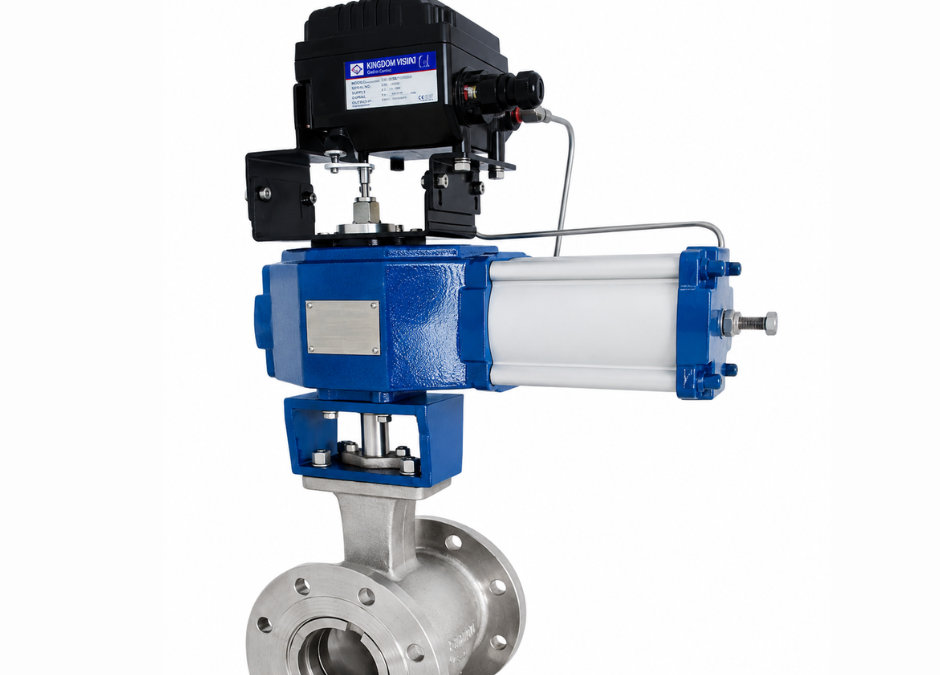
Rotary Control for Demanding Process Applications
Choosing a control valve becomes more challenging when the process involves contaminated media, suspended solids, high viscosity, cavitation or erosion. The valve must provide accurate flow regulation while also coping with demanding mechanical and process conditions.
The KVC-RP Eccentric Ball Valve / Rotary Globe Valve brings globe-valve controllability into a compact rotary control-valve design. Its guided eccentric shaft and spherical contoured plug/ball are specifically configured for flow control, combining rotary operation with an approximately linear inherent flow characteristic and a 100:1 adjustable ratio.
For applications where conventional control-valve designs may face challenges with difficult media, the KVC-RP provides another approach to throttling and process control.
What Is the KVC-RP Eccentric Ball Valve?
The KVC-RP is an eccentric angle-stroke rotary control valve.
Unlike a conventional concentric ball valve, its controlling element operates eccentrically in relation to the valve seat. This eccentric movement is central to how the valve controls flow and achieves seating.
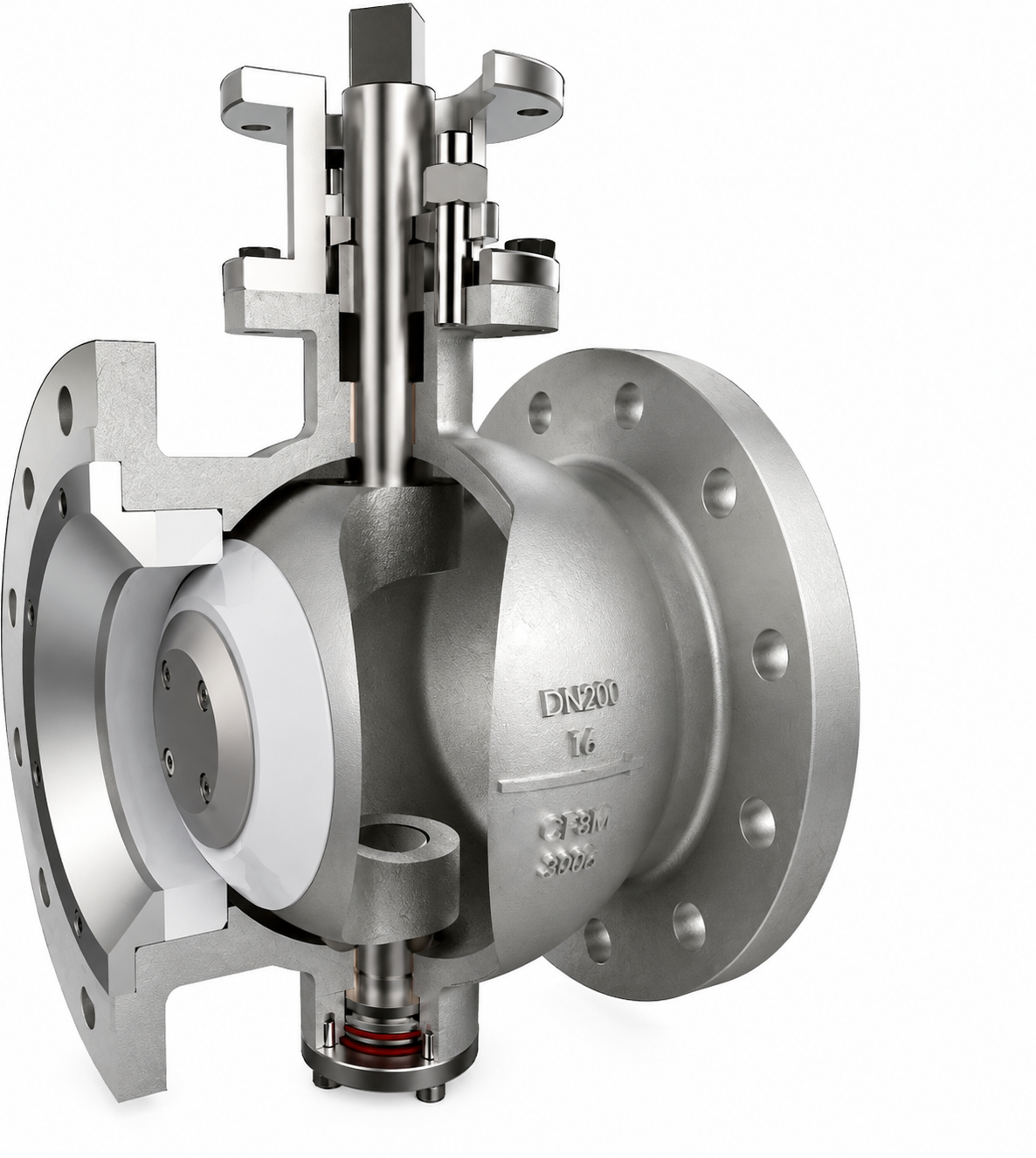
The KVC-RP uses a guided eccentric valve shaft together with a spherical contoured plug/ball. The body is designed to reduce flow resistance through the valve, while the contoured control element regulates the process fluid as the valve moves through its rotary stroke.
This makes an important distinction: the KVC-RP is not simply an isolation ball valve fitted with an actuator. It is designed as a modulating rotary control valve.
Why Do We Call the KVC-RP a Rotary Globe Valve?
The term Rotary Globe Valve describes one of the key ideas behind the KVC-RP: combining the controllability associated with a globe control valve with the compact operation of a rotary valve.
Traditional globe control valves regulate flow through linear stem and plug movement. The KVC-RP achieves its control action through rotary movement of an eccentric contoured plug/ball.
The result is a valve that brings together:
- compact rotary construction;
- globe-valve-style controllability;
- approximately linear inherent flow characteristics;
- eccentric plug movement;
- linear seating motion near closure; and
- a 100:1 adjustable ratio.
This is why terms such as eccentric ball valve, rotary globe valve and rotary plug valve can all be relevant when engineers are researching this category of control technology. However, these terms do not mean that every manufacturer’s design is mechanically identical.
For the KVC-RP specifically, RP Eccentric Ball Valve / Rotary Globe Valve is the product-family terminology we use.
How the Eccentric Design Reduces Friction and Torque
One of the most important features of the KVC-RP is what happens between the plug and seat as the valve operates.
The eccentric plug remains away from the seat through most of its rotational movement and makes contact with the seat only near final closure. This reduces the rubbing or friction that would otherwise occur between the sealing surfaces throughout the stroke.
Reduced friction means less torque is required to bring the valve into shut-off.
This operating principle also produces linear seating motion as the eccentric plug approaches the seat.
For demanding control applications, this geometry provides a useful combination: rotary throttling movement during control and controlled seating action as the valve approaches its closed position.
Approximately Linear Flow Control
A control valve needs to do considerably more than open and close. Its ability to regulate intermediate flow conditions is fundamental to process performance.
The KVC-RP has an approximately linear inherent flow characteristic.
As valve opening increases, its inherent flow capacity increases in an approximately linear manner. The KVC-RP also provides an adjustable ratio of 100:1, giving the valve a broad control range for applications where process demand varies substantially.
It is important to distinguish inherent valve characteristic from installed characteristic. Once any control valve is installed in a real process, pumps, piping, equipment and changing system pressure losses influence the relationship between valve travel and actual process flow.
Correct valve sizing therefore remains essential.
Built for Difficult Process Media
Many control applications involve fluids that are considerably more challenging than clean water or gas.
The KVC-RP is particularly suited to demanding process conditions involving polluted media, pulp, limestone, solid granular media, viscous fluids, cavitation and erosion.
Pulp and Polluted Media
Contaminated and fibrous process streams can create problems for control valves when material accumulates around internal components or interferes with the controlling and seating surfaces.
The KVC-RP’s rotary eccentric construction provides an alternative control-valve architecture for these services.
Limestone and Solid Granular Media
Processes containing suspended or granular solids can introduce both flow-control and wear challenges.
The KVC-RP can be configured for these applications, with an erosion-resistant design available as an option where the severity of the service requires it.
Viscous Fluids
High-viscosity media can behave very differently from clean, low-viscosity liquids as it passes through a control valve.
The KVC-RP’s contoured plug/ball and rotary control arrangement make it suitable for consideration in viscous-fluid applications.
Cavitating and Erosive Service
Cavitation can create significant noise, vibration and material damage when process conditions cause vapour bubbles to form and subsequently collapse.
The KVC-RP is suitable for consideration in cavitating and erosive applications, with erosion-resistant and low-noise designs available as options.
Actual valve selection for severe cavitation or erosion should always be based on the specific operating pressures, temperature, fluid properties, required Cv and severity of the service.
Replaceable Seat for Easier Maintenance
Control valves operating in demanding services inevitably require maintenance consideration.
The KVC-RP uses a replaceable seat retained by a retaining ring. The seat can be accessed and replaced by removing the retaining ring rather than treating the seating arrangement as a permanent part of the valve body.
Both metal and soft-seat options are available.
This gives us greater flexibility when matching the seating arrangement to process temperature, fluid characteristics and shut-off requirements.
Class IV and Class VI Shut-Off Options
The KVC-RP is available with different leakage performance depending on the selected configuration.
The standard tightness classification is:
ANSI/FCI 70-2-2006 Class IV
A Class VI bubble-tight option is also available.
The appropriate seating and leakage class should be selected according to the process rather than simply specifying the highest possible shut-off class.
Throttling duty, temperature, pressure differential, fluid properties and expected service conditions all need to be considered when selecting the seat configuration.
KVC-RP Size and Operating Range
The KVC-RP covers a broad range of industrial control applications.
| Technical Parameter | KVC-RP |
|---|---|
| Valve type | Eccentric angle-stroke rotary control valve |
| Product designation | RP Eccentric Ball Valve / Rotary Globe Valve |
| Nominal size range | DN50–DN300 |
| Connection | Flanged |
| Length | ASME/ISA S75.04 |
| Temperature range | -40°C to +400°C |
| Inherent flow characteristic | Approximately linear |
| Adjustable ratio | 100:1 |
| Closing direction | Clockwise |
| Standard tightness | ANSI/FCI 70-2-2006 Class IV |
| Optional tightness | Class VI bubble-tight |
| Seat options | Metal or soft |
| Packing options | PTFE or flexible graphite |
The exact allowable operating pressure depends on factors including valve body material, pressure class and operating temperature.
KVC-RP Rated Cv Values
Control-valve sizing depends on the valve’s flow coefficient, or Cv.
The KVC-RP range offers the following rated Cv values from DN50 through DN300:
| Nominal Size | Inch | Metal-Seated Rated Cv | Soft-Seated Rated Cv |
|---|---|---|---|
| DN50 | 2 | 50 | 50 |
| DN65 | 2½ | 100 | 85 |
| DN80 | 3 | 150 | 120 |
| DN100 | 4 | 240 | 195 |
| DN125 | 5 | 320 | 290 |
| DN150 | 6 | 500 | 480 |
| DN200 | 8 | 800 | 800 |
| DN250 | 10 | 1250 | 1150 |
| DN300 | 12 | 1800 | 1550 |
The difference between metal- and soft-seated Cv values at several sizes is important when sizing the valve. Seat configuration should therefore be included when establishing the required KVC-RP size rather than selecting the valve from nominal pipe diameter alone.
Body and Trim Material Options
Material selection is particularly important when a control valve is handling corrosive, erosive, contaminated or high-temperature media.
KVC-RP body material options include:
WCB, CF8, CF8M and SAF2205.
Trim options include 316 with alloy and tungsten options, allowing the internal construction to be selected according to the demands of the application.
The correct material combination depends on the process medium, operating pressure, temperature, corrosion potential and erosion severity.
Pressure class must also be considered together with temperature. The allowable working pressure of a valve body material changes as operating temperature changes, so nominal pressure rating alone should never be used as the complete basis for valve selection.
PTFE and Flexible Graphite Packing
The KVC-RP is available with two primary packing options across different temperature ranges:
- PTFE packing: -40°C to +150°C
- Flexible graphite packing: -40°C to +400°C
The rotary operating principle is also intended to improve packing life.
Instead of the reciprocating stem movement associated with a conventional linear globe valve, the KVC-RP operates through rotary shaft movement. This is another advantage of combining globe-valve control principles with a rotary architecture.
Integral Body Construction
The KVC-RP uses an integral body and bonnet casting.
This construction eliminates separate body-to-bonnet sealing interfaces found in valve designs using distinct body and bonnet components. Packing remains the principal dynamic sealing arrangement around the operating shaft.
The result is a compact control-valve construction with fewer body-joint sealing interfaces.
Special KVC-RP Configurations
Not every industrial process can be addressed with a standard control-valve arrangement. We therefore have several KVC-RP design options for more demanding duties.
Thermal Insulation Jacket
A thermal insulation jacket is available for processes where temperature management around the valve is important, including media susceptible to crystallisation.
Erosion-Resistant Design
For applications involving erosive process conditions, an erosion-resistant configuration is available.
Low-Noise Design
A low-noise design is also available for applications where control-valve noise requires additional attention.
These options need to be selected against actual process conditions rather than treated as universal configurations.
KVC-RP vs Segmented V-Ball Control Valves
The KVC-RP and our segmented/V-ball control valves are both rotary control technologies, but they are different control-valve families.
A segmented V-ball valve uses a segmented ball or V-shaped control element to regulate flow.
The KVC-RP instead uses a guided eccentric shaft and spherical contoured plug/ball, with eccentric movement that brings the plug into contact with the seat near final closure.
These differences matter.
Cv values, seating arrangements, pressure-temperature limits, materials and other specifications from one valve family should never automatically be applied to the other.
Choosing between an eccentric rotary globe valve and a segmented V-ball control valve requires us to look at the actual process conditions and determine which control-valve geometry best suits the application.
When Should You Consider the KVC-RP?
The KVC-RP is particularly worth considering when you need:
- a rotary valve designed specifically for modulating control;
- globe-valve-style controllability in a compact rotary construction;
- an approximately linear inherent flow characteristic;
- a 100:1 adjustable ratio;
- reduced plug-to-seat friction during operation;
- metal or soft-seat options;
- replaceable seating components;
- control of polluted or solids-containing media;
- handling of pulp, limestone or granular media;
- control of viscous fluids;
- a valve for cavitating or erosive service;
- high-temperature capability with the appropriate configuration; or
- optional erosion-resistant, thermal-jacketed or low-noise designs.
Correct Control Valve Sizing Is Essential
Even the right control-valve technology can perform poorly if it is incorrectly sized.
Selecting a KVC-RP simply because its nominal size matches the pipeline can result in an oversized or undersized control valve.
For accurate sizing and selection, we need to understand the actual process conditions, including:
- process medium;
- minimum, normal and maximum flow rate;
- inlet pressure;
- outlet pressure or differential pressure;
- operating temperature;
- fluid density or specific gravity;
- vapour pressure where relevant;
- pipeline size;
- required leakage class;
- material requirements;
- minimum and maximum operating conditions; and
- actuator and fail-action requirements.
For difficult liquid applications, we also need to evaluate the potential for cavitation, flashing and erosion.
The objective is not simply to find a valve that passes the maximum flow. We want to select a control valve that provides useful control across the application’s actual operating range.
Why Choose the KVC-RP Eccentric Ball Valve?
The KVC-RP brings together several characteristics that are valuable in demanding control applications.
Its guided eccentric shaft and spherical contoured plug/ball provide the foundation for controlled flow regulation. The eccentric geometry minimises plug-to-seat contact through most of the operating stroke and creates linear seating motion near closure.
At the same time, the valve provides an approximately linear inherent characteristic, 100:1 adjustable ratio, replaceable seat, metal and soft-seat options and a broad DN25–DN300 size range.
Most importantly, it gives engineers another option between conventional linear globe-valve technology and other types of rotary control valves.
For polluted, viscous, solids-bearing, cavitating or erosive processes, that difference in valve geometry can be significant.
Talk to KV Controls About Your KVC-RP Application
Every control-valve application is different.
At KV Controls, we look beyond line size and pressure class to understand what the valve will actually experience in operation.
If you are considering the KVC-RP Eccentric Ball Valve / Rotary Globe Valve, send us your process conditions, including the medium, flow rates, inlet and outlet pressures, temperature, line size and required shut-off performance.
We can then evaluate the application and help select the appropriate KVC-RP valve size, Cv, seat configuration, materials and actuation arrangement for the duty.







CONTACT
KV CONTROLS
Partner with KV Controls
Whether you require a single control valve, a complete valve automation package, or support for a major industrial project, KV Controls delivers the expertise, products, and service needed to help your operation succeed.
Contact our team today to discuss your valve, actuator, and flow control requirements.
+27 16 100 4592
sales@kvcontrols.co.za
repairs@kvcontrols.co.za
FOLLOW US
Proudly designed by Bunnypants Graphic & Web Design Studio | 2023