Intro
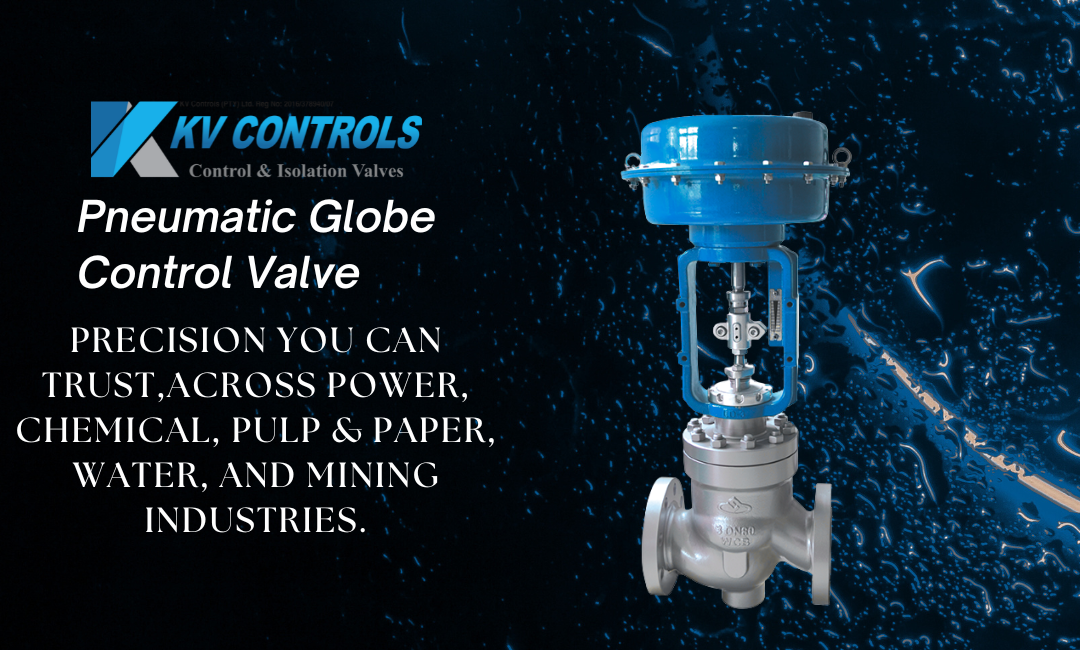
In process plants, consistency is everything—flow, pressure, and temperature must stay on target despite changing loads. Pneumatic globe control valves are a proven way to achieve that stability. In this guide, we unpack what they are, how they work, how they regulate critical variables, and the differences versus electric actuation—so you can specify the right solution with confidence.
1) What is a pneumatic globe control valve—and how does it work?
A globe control valve is a linear-motion valve designed for precise throttling of fluids (liquids, gases, steam). The name comes from its globular body shape and internal flow path.
Core principle:
A plug (disc) moves up or down against a seat to change the flow area. Smaller opening = higher pressure drop = lower flow. Larger opening = lower pressure drop = higher flow.
Pneumatic actuation:
-
An air-driven actuator (usually diaphragm or piston) converts a control signal (e.g., 3–15 psi / 0.2–1.0 bar) into linear stem motion.
-
A positioner ensures the plug reaches—and holds—the exact opening that corresponds to the 4–20 mA (or pneumatic) command from the controller/DCS.
-
Fail-safe action (fail-open or fail-closed) is set by spring orientation and actuator design.
Why plants love pneumatics: Fast response, high force for tight shut-off, intrinsic safety in hazardous areas, and simple, robust mechanics.
2) How does a globe control valve regulate flow, pressure, and temperature?
Regulation is achieved by modulating the valve opening to maintain a setpoint sent from the control system.
Flow control
-
The valve follows a defined flow characteristic (often equal percentage for stable turndown), ensuring predictable changes in Cv as the plug travels.
-
The positioner trims stem position to match the requested output signal.
Pressure control
-
For upstream pressure control, the valve throttles downstream to maintain a target upstream pressure.
-
For downstream pressure control, it modulates to hold a target pressure after the valve, absorbing process disturbances.
Temperature control
-
In steam heating, the valve meters steam to a heat exchanger/jacket; the temperature controller adjusts valve opening to achieve the temperature setpoint.
-
In cooling loops, it meters chilled water or coolant with the same logic.
Key performance enablers
-
Trim design: characterized plugs, low-noise/anti-cavitation trim, hardened seats.
-
Positioner quality: smart diagnostics, auto-tuning, friction compensation.
-
Air quality: clean, dry instrument air for repeatable response.
3)Pneumatic Globe Control Valves — What to Know
Strengths
-
Very fast response and high thrust for tight throttling control
-
Inherently safer in hazardous (Ex) areas—no arcing/sparking sources
-
Simple, reliable fail-safe with spring-return (fail-open/close) options
Best for
-
Steam service and high-temperature duties
-
Fast or upset-prone processes that need quick moves
-
Hazardous zones and high-cycling applications
Consider
-
Requires clean, dry instrument air (size the air set correctly)
-
Very large actuators may need volume boosters/positioner tuning
-
Add lock-up or quick-exhaust valves where needed for safety states
Rule of thumb
-
Pick pneumatic when you need speed, force, and Ex safety, and when an instrument-air system is available. If air isn’t available, consider other actuation types.
4) Main parts of a pneumatic globe control valve
-
Body: Pressure-containing shell with flow path (often globe-style S-path) available in materials like carbon steel, stainless steel, and alloys.
-
Bonnet: Encloses packing and guides the stem; options include standard, extended (for cryogenic), and finned (for high temperature).
-
Trim (plug, seat, stem, guides): Determines capacity (Cv), characteristic (equal-percentage, linear), shut-off class, noise/cavitation performance.
-
Packing: Seals around the stem (PTFE, graphite, live-loaded) to control fugitive emissions and friction.
-
Actuator (pneumatic, diaphragm/piston): Converts air pressure to linear motion; defines fail-open/fail-closed.
-
Positioner (pneumatic/electropneumatic/smart): Translates the control signal into precise stem position, adds diagnostics, and can support HART/Fieldbus.
-
Accessories: I/P transducers, volume boosters, air filters/regulators, limit switches, solenoids, lock-up valves.
Where pneumatic globe valves are used
-
Steam and condensate: Heat exchangers, jackets, reboilers.
-
Utilities: Cooling water, chilled water, condensate return.
-
Process gases: Nitrogen, natural gas (non-SIS), air.
-
Chemical dosing & blending: Precise ratio control with characterized trim.
-
Pulp & paper, mining, food & beverage, power, oil & gas: Broad applicability wherever accurate throttling is needed.
Selection checklist (quick)
-
Service: Fluid type, temperature, pressure, phase (liquid/gas/steam).
-
Sizing: Required Cv, rangeability, expected ΔP; target characteristic (often equal-percentage).
-
Shut-off: Leakage class, soft vs metal seat, bidirectional needs.
-
Materials: Body/trim metallurgy vs corrosion/erosion/cavitation risk.
-
Actuation: Fail action, stroke speed, air supply quality/pressure.
-
Compliance: Emissions packing, noise limits, SIL requirements (if any).
-
Environment: Hazardous area classification, ambient extremes.
Maintenance tips for long, stable service
-
Keep instrument air clean/dry; service filters and FRLs.
-
Enable positioner diagnostics; schedule partial-stroke/step tests.
-
Inspect packing and retorque or replace per OEM guidance.
-
For erosive/cavitating service, select hardened or multi-stage trim and monitor wear.
FAQ
Q: What flow characteristic should I pick?
A: Equal-percentage is most common—it delivers stable control over a wide turndown and handles process non-linearities well.
Q: Can a globe valve do tight shut-off?
A: Yes—choose the right plug/seat combination and actuator thrust to meet your required leakage class.
Q: What fail action should I choose?
A: Use fail-closed for energy/steam isolation and fail-open where safety or process continuity demands it. Confirm with your HAZOP.
Partner with KV Controls
Need help sizing and specifying a pneumatic globe control valve for your plant? KV Controls can recommend the right body, trim, and positioner package for your medium, pressure/temperature range, and control goals. Get expert guidance and fast turnaround—talk to our team today.
READ MORE;
Pneumatic Globe Control Valve with SRD988
Raven™ Trim for Severe Service
Desuperheater: Precise Steam Control
Valves for the Hydrogen Industry-KV Controls
CHEMICAL AND PETROCHEMICAL
ACTUATORS
ARC VALVES
BALL VALVE
BUTTERFLY VALVE
DESUPERHEATER
DIAPHRAGM VALVE
GLOBE CONTROL VALVE
GATE, GLOBE & CHECK
KNIFEGATE VALVE
PLUG VALVE
POSITIONERS
SAFETY VALVE
SEGMENTED BALL VALVE
SOLENOID VALVE